
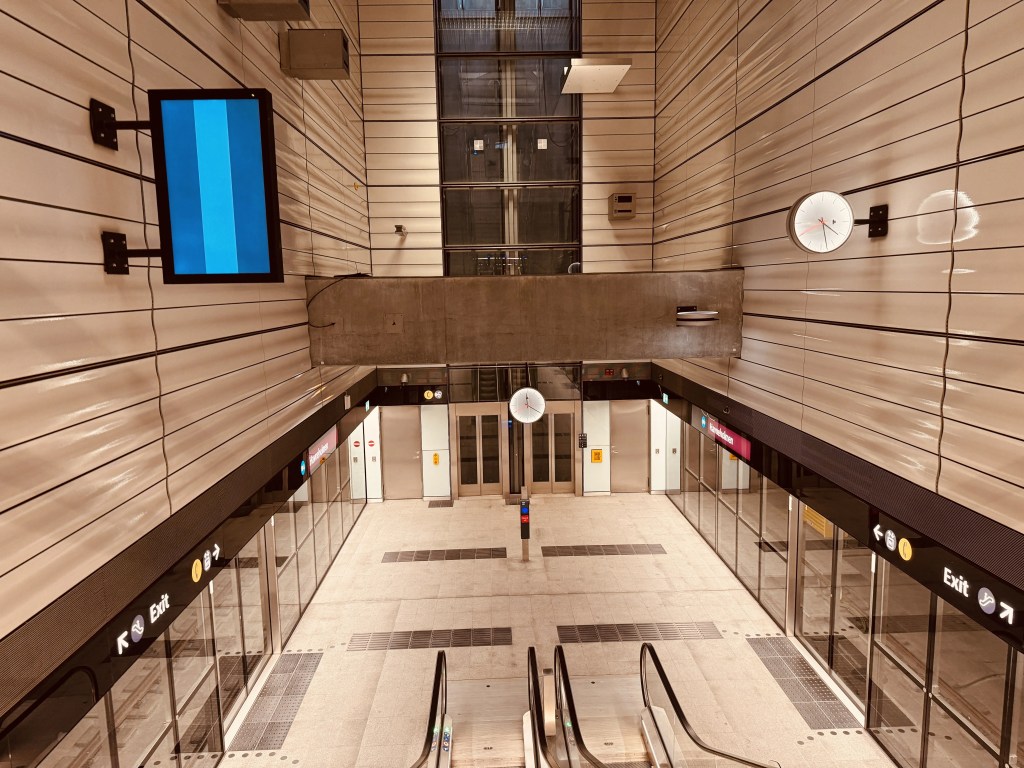
In June 2024, a new metro line, the M4, opened in Copenhagen, connecting the main city with the south coast. With its modern architecture, each station on the line offers something unique and intriguing. My personal favorite is Havneholmen Station, where the concept is particularly striking.
Upon entering, you immediately sense something unusual: clocks spin, signs, checkpoints, even a fire extinguisher are upside down, while benches and bins cling to the walls and ceilings! This imaginative design, created by the art team SUPERFLEX, envisions the metro (aptly named Super Metro) as traveling at the speed of light, making time relative. Passengers arrive younger at their destination, clocks tick backwards, and the “upper world” becomes the “lower world.”
The Danes don’t rush to catch their trains or buses; they plan their time and trust public transport. For me, entering a station usually means racing to catch the next train. Yet, upon stepping into Havneholmen Station for the first time, I felt my urgency melt away. I instinctively looked at the clock with a familiar anxiety, but then it hit me: this was art doing its magic, shifting my focus away from the rush of daily life and onto the fluidity of time itself.
For a moment, the bustling city routine fell away, and I remembered the mystery of time that so many thinkers, from physicists to artists, have tried to capture. Time has always been a complex and captivating concept, explored across sciences and aspects of life. Physicists study it, academics write about it, authors and poets attempt to grasp it, and artists draw inspiration from its mystery.
Stephen Hawking once said:
“Time is the most mysterious force in the universe. It shapes and determines the fabric of everything around us, yet it’s elusive and impossible to hold.“
In daily life, however, especially in cities, time is more fact than mystery. We keep moving: catching trains, working, exercising, chatting, scrolling, programming, and so on. But do we ever pause to consider the time passing by or simply “is”? Do we stop to breathe, even for a moment—1, 2, 3?
Erwin Schrödinger reminds us:
“The present is the only thing that has no end.“
At Havneholmen Station, Dalí’s painting The Persistence of Memory came to mind, with its melting clocks in a desolate landscape. Dalí, fascinated by science and Einstein’s theory of relativity, depicted time’s fluidity. It’s amazing how art can disrupt the mundane, leading us to wander beyond routine, inspiring even a standard metro line to feel transformative.
Richard Feynman expressed it well:
“Time is what happens when nothing else does.“
If we take even a brief moment—regardless of how anxious, hurried, or overwhelmed we may feel—to just be with time, we connect with the present, the only thing that truly exists. It’s simply us, here and now, within the boundless flow of time.
Would you be interested in visiting Copenhagen and this station? Do you like it when more and more art sceneries are integrated into urban practical environments?
 Alexandra Konstanti
Leave a comment