

The name Maria is one of the most popular given names in the world. It ranks 18th in the United States and is particularly common among populations of Hispanic origin, with Mexico leading the way with 4,285,344 Marias and Spain where 8.5% of the population bears the name or its variations (MyNameStats.com and ThePopulationProject.org).
One of the most iconic Marias in history is the Virgin Mary, who, according to Christian tradition, gave birth to baby Jesus. Over the centuries, countless women named Maria have made pivotal contributions, groundbreaking decisions, and innovative strides that have shaped the areas of life as we know them today. These women had the courage to rise above challenges, honor their calling and talents, and defy patriarchal norms and obstacles to become entrepreneurs and leaders in their time.
Let’s meet two of these remarkable Marias. Each of them will be presented with facts and accomplishments on the left side, and on the right side, with the adversities and hardships that existed in the background of their lives.

Maria Montessori was born 31st August 1870 in Chiavalle, Italy.
The child does not work in order to move or in order to become intelligent. He works to adapt to his environment. It is essential that he has many experiences in the environment if he is to do this.
Maria Montessori
The 1946 London Lectures, p. 131
| She was the first woman in Italy that graduated from the University of Rome (Maria graduated in medicine in 1896). | At this time literacy rates were very low and women were expected to prioritize domestic work over anything. Maria’s father was against her decision to study. When she visited the University of Rome to discuss her plans, a professor of medicine declined her apply to the program, but Maria enrolled anyway. She was not even allowed to walk alone to the school’s corridors and she should be accompanied by a male relative. |
| While working as a doctor assistant at the psychiatric clinic of the University of Rome, she became interested in educational methods for intellectually disabled children. | She had radical ideas about women’s rights. She believed that women should be paid equally with men. She was accused of overseeing children who, by the standards of society, were incompetent. |
| As Director of the State Orthophrenic School in Rome, she launched extremely successful methods. | She used every mean and knowledge she had and drove those excluded children to exceed the societal expectations. |
| In 1907 she opened her first preschool for children age 3 to six, applying her educational methods to children of normal intelligence. That was the beginning of so many other Montessori school openings over Europe, United States and over the world. Her new, unique educational methods influenced the pedagogic field and changed the way educators approach children’s teaching. | As the Montessori method gained global recognition, political tensions in Italy escalated with Mussolini’s rise to power. Initially, Montessori accepted his support, believing her work could promote peace, while Mussolini valued the disciplined behavior of Montessori students. However, when it became clear he intended to use her schools to cultivate young fascists, Montessori shut down her schools in Italy and fled the country. |
Maria Montessori never let adversity stop her. She stayed true to her beliefs, fought for underprivileged children society had written off, and was a strong supporter of the women’s movement, always standing for equality and opportunity.
Her remarkable contributions earned her Nobel Peace Prize nominations in 1949, 1950, and 1951. She passed away in 1952 in the Netherlands, but her name and legacy continue to shine brightly, inspiring generations worldwide.
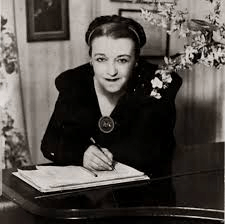
Maria Joaquina de la Portilla Torres, widely known as Maria Grever, was born 14th of September 1885 in Leon, Mexico.
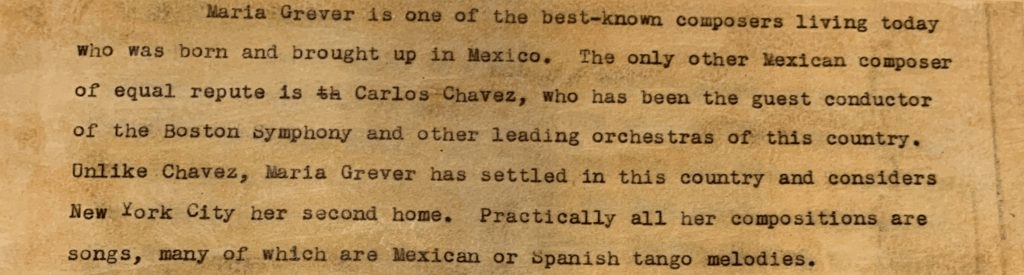
Courtesy of New York Public Library. NBC Research Clipping Files, Maria Grever.
| She was one of the greatest composers, having created nearly 1,000 songs from early 20s till her death in 1951. | Maria emigrated to New York City in 1916 in order to escape the political turbulences amidst the Mexican Revolution. She separated from her husband and ended up as a single mother with two children in New York. This time was just the very early beginnings of the foundation for women’ s civil rights. It wasn’t until 1920 when the 19th Amendment was ratified, giving women the right to vote. |
| Her first big hit “To A Wave” sold over 3,000,000 copies. | She was not just an immigrant and a single mom in one of the most challenging cities, but also a woman in a field that is male dominant. |
| In 1934 her hit “Quando Vuelva a Tu Lado” was translated in english and won a grammy in 1959 for best R&B performance. | Maria organised cabarets with her songs, that performed herself. She had also composed one- act operas and choral works. Many critics were quick to label her music as “not serious”, however they admitted her talent of creating spontaneous melody. |
| She had tremendous success as a producer that a nespaper review for the musical comedy “Viva O’Brien” mentioned: “The new and outstanding personality of the production appears to be Maria Grever.” $80,000 (today’s amound estimated in 1,5 million) was invested on the production. | “She oftentimes sold her music as opposed to keeping ownership and collecting royalties. It was due to her genius that she was able to make it work” Stuart Livingston– her great- grandson (soundgirls.org). Maria wrote so much music and did lots of buyouts. She was running her creative business all by herself. |
Despite countless obstacles and challenges stacked against her, this remarkable woman thrived in an industry where women were not even expected to have a presence. She became the first Latin American woman to achieve such global success on such a grand scale.
These were two extraordinary women—two unstoppable Marias. Yet, across time and around the world, there are countless Marias, well-known or not, who refuse to give up, persist and insist, and carve out their own paths in their fields.
These Marias remind us to celebrate the countless women, named Maria or not, who are taking risks and fail, suffer pain but stay and grow strong, who continue to firmly plant their feet on the ground, and with small or big steps, defy expectations and change the world.
Was there a woman—famous or not—whose story of persistence has shaped your perspective?
 Alexandra Konstanti
Leave a comment