
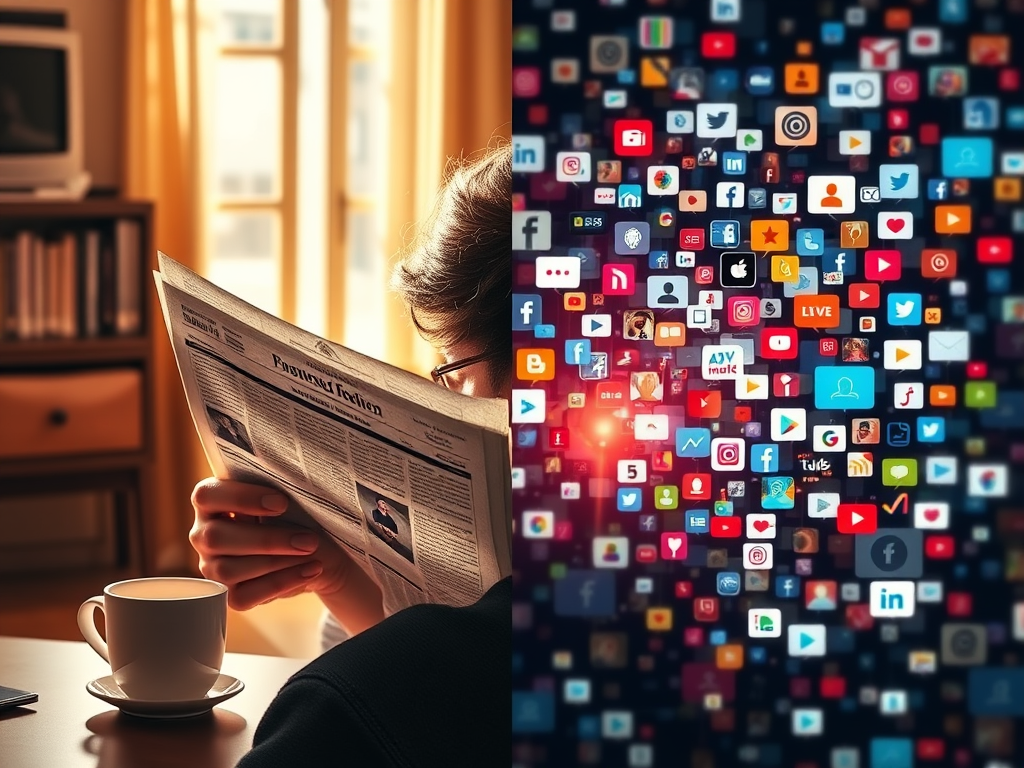
Or just overwhelmed?
We would expect that living in a modern digital world—where news can travel across the globe in a millisecond—would make us the most well-informed generation in history. However, many of us, including me, often feel more lost, confused, and unsure about what is actually true. And the issue isn’t just “fake news”—it’s the sheer flood of information available for consumption daily and our inability to process it effectively.
The News Era: Once Upon a Time
Once upon a time, newspapers and the 9 o’clock news were the primary sources of information. I can vividly picture my father reading his Sunday newspaper with his morning coffee, fully immersed in well-researched and thoughtfully written pieces. Back then, we understood the value of a great argument and undeniable facts.
Nowadays, things are completely different. TikTok, Instagram, and Twitter have become the main sources of information. While the democratization of ideas and opinions is certainly a good thing, it also comes with a downside. Our ability to read critically, analyze deeply, and focus on a well-crafted article has significantly declined. News is now reduced to flashy headlines designed for clicks and engagement, soundbites meant to go viral, and bite-sized pieces of information stripped of depth and nuance. We’ve become accustomed to engaging emotionally rather than understanding and reflecting.
The Algorithmic Filter Bubble
As I scroll through Instagram, I often wonder how the algorithm decides what to show me. Beyond my own preferences and those of my friends, trending topics and system-driven content dictate what appears on my feed. It feels like I’m trapped in an echo chamber, where I’m constantly fed perspectives that reinforce my existing beliefs and an idealized version of life curated by others. Instead of broadening our worldview, we narrow it.
The result? A fragmented reality where different groups of people exist in completely different informational universes. It’s no longer just about bias in journalism; it’s about how platforms incentivize content that sparks outrage, keeps us scrolling, and maximizes engagement—often at the expense of nuance and truth.
The Decline of Deep Reading and Critical Thinking
I can’t remember the last time I sat down to read a full-length investigative report without getting distracted. The mere thought of reading and analyzing an in-depth piece can feel exhausting. AI tools now help summarize large reports in seconds, which is undeniably useful—especially for those who struggle with traditional reading methods.
But we’re witnessing a cognitive shift. Our brains have been rewired to crave fast, fragmented information, making deep reading and critical thinking harder. We prioritize speed over accuracy, engagement over understanding.
What Can We Do:
- Be intentional with our media consumption. Instead of passively scrolling, we can actively seek out credible sources and take time to read beyond headlines.
- Diversify your sources. We can challenge ourselves to read perspectives we don’t always agree with to break out of our filter bubble.
- Engage critically. Before sharing an article or reacting emotionally, we can take a moment to verify its accuracy and consider the context.
- Embrace long-form content and integrate it into life once in a while! Books, well-researched articles, and in-depth reports provide a more complete understanding of issues than short viral clips.
Final Thoughts
The challenge isn’t just fighting misinformation; it’s learning how to navigate an overwhelming sea of content with clarity and discernment. In an age of infinite information, true knowledge comes not from knowing everything, but from knowing what to pay attention to.
When was the last time you’ve read a full- lenght investigative report or article?
 Alexandra Konstanti
Leave a comment