
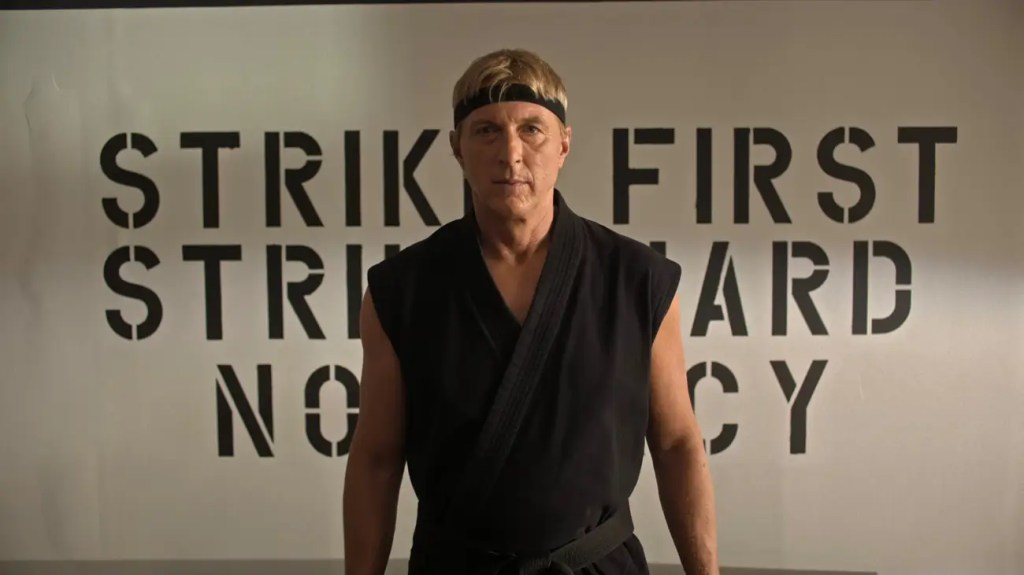
It was 2018 when Season 1 of Cobra Kai launched. Being a kid of the late ’80s and literally growing up with The Karate Kid, I was skeptical.
Even now, as I write about The Karate Kid, I find myself reliving my childhood—the frustration of watching Daniel LaRusso struggle as the underdog, the warmth of seeing teenagers fall in love and hang out at the beach, and the anticipation of justice finally catching up to Johnny, the “bad boy,” the golden champion of Cobra Kai, and Daniel’s sworn enemy. The famous crane kick, the one that secured Daniel’s victory over Johnny in the final match of the All-Valley Karate Tournament, was stuck in my mind for weeks. The power, the persistence, the courage, and that glorious ending—it made me feel invincible, as if justice always prevailed in the end.
I didn’t want that feeling to be ruined by a cheesy sequel. But Cobra Kai‘s first season did not disappoint. It was fascinating to see how those teenagers had evolved into adults, to see where life had taken them.
The seasons that followed had their moments, but as the massive karate brawls between kids became more over-the-top, the show started feeling like a parody. I was disappointed. My childhood memories whispered, “We will always have The Karate Kid,” and I kept watching Cobra Kai just to roll my eyes and say, “Oh, come on… not again!”
And yet, here we are. The Cobra Kai season finale. The triumph of our late ’80s–early ’90s nostalgia. The story that was always meant to be told.
After all the endless karate duels between Miyagi-Do and Cobra Kai, the rivalries, the reconciliations, and the teenagers growing up before our eyes, we finally reached the ultimate moment. Johnny’s moment. Because this was Johnny’s story all along. The gradual transition from an angry man stuck in the past—an adult everyone had labeled and dismissed—to someone who finally sets aside revenge and ego, softening as he learns from those around him. The story of a former bully who faces his pain, acknowledges it, and finds redemption. And that is always the most powerful story to tell.
Daniel and Johnny, once bitter enemies, now share a deep, hard-earned friendship. But it wasn’t easy—it took fights, misunderstandings, moments of near-reconciliation only to reject each other again at the last second. And in the final season, they finally get it. They embrace each other’s perspectives, integrate their styles, and embody the yin-yang philosophy. They forgive, but they don’t forget. They don’t forget that they will always carry those teenagers inside them—the ones who still want to play, to fight, to have fun, to be a little reckless. To dream.
And for this, the creators of Cobra Kai didn’t fail me. They knew exactly when to drop the legendary song, the official Karate Kid 1984 soundtrack “You’re The Best” my heart was pounding. In that moment, I was back in my childhood bedroom, watching The Karate Kid all over again—watching someone push beyond their fears and limitations. The story one more repeats itself, but it’s for the “loser”, Johnny.
The beach scene, where Daniel teaches Johnny the crane kick technique, was the ultimate proof of their growth—two rivals finally merging into one understanding. But Cobra Kai didn’t take the predictable route. Johnny didn’t win his final fight with a crane kick, and I’m glad he didn’t. It was debated, expected even, but it wouldn’t have been his ending. Johnny deserved his own victory—because in the end, it was his story. And after everything, he was, after all, an okay guy.
When it ended, a wave of mixed emotions hit me. I couldn’t believe I had just witnessed the full journey of characters who had shaped my early years. It was as if I had traveled back to the ’90s and grown older with them. The ultimate nostalgic time warp.
What do you think? When does your ’90s nostalgia hit its peak?
 Alexandra Konstanti
Leave a comment